CATCHY

Access code

That code is not right.

CATCHY
1Test rig 2Net drag 3Deployment 4Impact 5Where & next

CATCHY · test plan

From calculation
to measurement.

One rig on a car roof, three tests. Each one checks a number we only estimated so far.

01Test rigCar + load cells 02Net dragIs the CFD right? 03DeploymentDoes the mechanism open? 04ImpactDoes it hold the target? 05Where & nextSites, safety, milestone

01 · Test rig

How do we get real flight loads without flying?

Drive them. A custom holder on the car roof carries the net or a drone prototype. Load cells measure the force on it at speed.
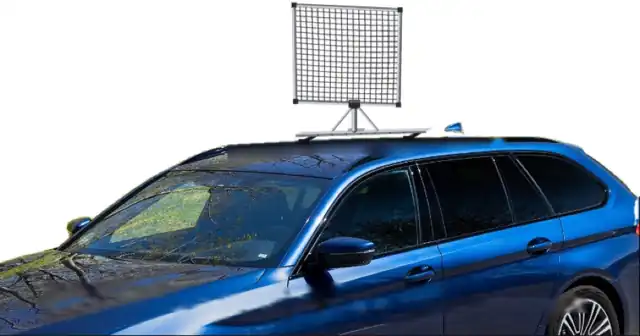
Car with a net frame mounted on a roof holder 1Net / prototype 2Holder + load cells 3Car = airspeed
1

MountNet or 3D-printed prototype on the holder

2

DriveUp to the target drone's top speed: 21 m/s ≈ 76 km/h

3

MeasureForce on the load cells + video

4

CompareMeasured vs. our hand estimates and CFD

Review 1 · upcoming tests

02 · Net drag

Is our CFD for the net right?

Net drag sets how much thrust we need. We measure it directly and validate the simulation.

We expect

≈ 32N net
≈ 14N frame

1.5 m² net, 10 mm frame, 75 km/h

We measure

  • Drag force on the load cells
  • Over a speed sweep
  • Net alone, then net + frame

It decides

  • Trust the CFD, or correct it
  • Thrust and motor sizing
  • Net mesh choice
Backup · net and frame assumptions
Net area1.5 m²
Coarse mesh3 mm cord, 10 cm spacing
Fine mesh0.3 mm cord, 4 cm spacing
Frame10 mm cylinder
Speed75 km/h (≈ target top speed)
Expected drag · net / frame≈ 32 N / ≈ 14 N

D = ½·ρ·v²·CD·A grows with v², so the speed sweep also checks the drag coefficient, not just one point.

Review 1 · net drag estimate · Net Drag Calculator

03 · Mechanism deployment

Does the mechanism open in the airflow?

3D-printed models of our leading mechanisms, opened at speed on the rig.

Q1

Does it work?

Opens and locks fully at speed. Filmed.

Resultyes / no
Q2

How big can the net get?

Increase net size until it no longer opens cleanly.

Resultmax m²
Q3

Forces on the mechanism?

Load cells during opening and when locked.
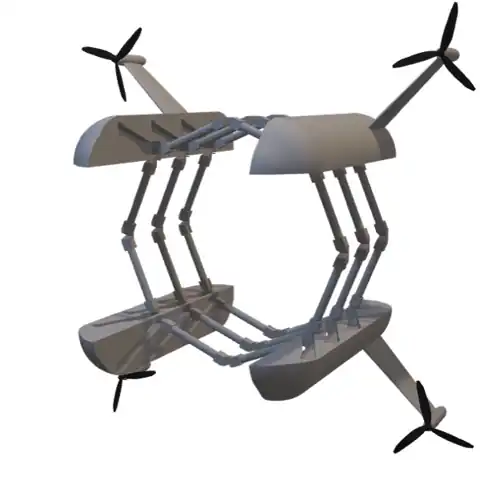
Expect≈ 10 N
Hexamorph net frame model
Backup · expected mechanism loads
MechanismQuantityEstimate
Octo-morphing X wingForce per joint, flight≈ 10 N
Octo-morphing X wingLock torque, full thrust0.84 N·m
HexamorphLock torque, full thrust8.16 N·m (~10×)
Jaw X wingForce on mechanism54 N
Fold-out droneDrag on one arm (1.5 m² net)12.5 N

Leading ideas from Review 1: Octo-morphing X wing (expansion ratio 12) and Trapezoidal H wing (expansion ratio 6).

Review 1 · Mechanism Forces.xlsx · Frame_Calculations.xlsx

04 · Impact behaviour

What happens when the target hits the net?

The catch itself: the system has to survive it, and the target has to stay inside.

Q1

How does the impact affect the system?

Peak force on the load cells, frame and joints after the hit.

Expect on the net≈ 460 N
Q2

Does it enclose the target?

Target stays in the net, no bounce-out, no contact with the rotors.

Resultyes / no
Backup · impact assumptions
Target drone1 kg
Relative speed at catch10 m/s
Load on the net (net drag + target)≈ 460 N
Tube bending stress · octagon / hexagon39.6 / 71.9 MPa
Jaw: net deflection · peak force on drone43 mm · 5.66 kN (upper bound)

Catching at matched speed keeps the relative speed and the impact low.

Frame_Calculations.xlsx · Mechanism Forces.xlsx

05 · Where & next

Where we test, safely, and what it unlocks.

ML Hall
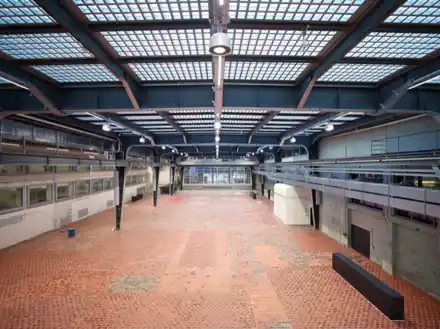
INDOORML HallFunctionality tests
Dübendorf airfield
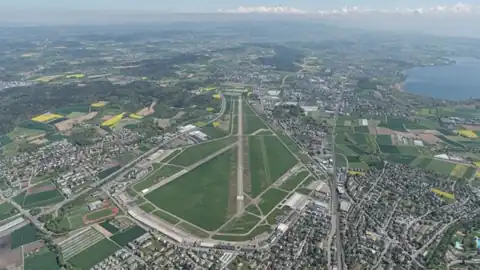
CARDübendorfHigh-speed car tests, aerodynamics
Hinwil model airfield
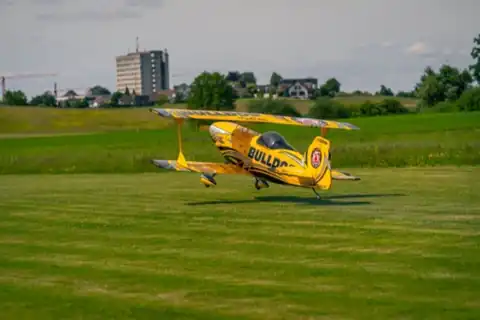
OUTDOORHinwilFirst outdoor interception tests
Results feed Milestone 1: choose the mechanism and the drone geometry.
Backup · risks and countermeasures
High-speed crash→Open areas without people or buildings, safety shelter
Destructive impact→Catch at matched speed, redundant control surfaces
Self-entanglement→Net clear of the rotors, prop guards, drop tests
Loss of communication→Failsafe: hover, return home, land
Autonomy failure→Emergency human override
Environment→Indoor first; outdoors only within wind limits
M1Choose mechanismand drone geometry
M2Mechanism prototypefirst flight of test drone
M3Integrated flightfirst full system flight
M4MVP demoautonomous capture

Review 1 · test sites, risks, milestones

← → to move